
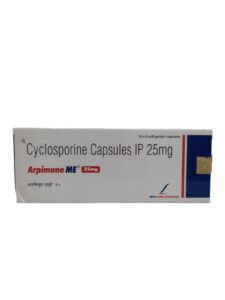
Arpimune capsule are immunosuppreasent medications used to prevent organ rejection after transplant (kidney, liver ,heart) and treat severe autoimmune conditions like rheumatoid arthritis,psoriasis and nephrotic syndrome. they work by inhibiting T-lymphocytes to reduce immune system over activity.
Importance of correct dosage
l Prevention of organ rejection
After a transplant, the immune system views the new organ as a foreign. Arpimune suppresses the immune response to prevent rejection . Too low a dose can lead to the body attacking new organ ,resulting in organ failure.
l Management of Autoimmune conditions
in cases of severe rheumatoid arthritis or psoriasis , correct dosing reduces joint damage and improves skin symptoms by suppressing T-lymphocyte activity.
l Avoiding Toxicity
Too high a dose can cause significant, dangerous side effects ,including kidney damage (nephrotoxicity) ,liver damage, high blood pressure and tremors.
l Maintaining consistent blood levels: Arpimune should be taken consistently at the same time each day (with or without food) to keep a steady ,effective level of the medication in the body.
Difference between Arpimune 25mg &50 mg
Arpimune (cyclosporine) 25 mg and 50 mg capsules differ primarily in strength ,used for flexible dosing in organ transplant rejection prevention and autoimmune conditions like rheumatoid arthritis or psoriasis. While both contain the same active ingredient, the 50 mg capsule is double the potency of the 25 mg,typically selected based on patient weight ,condition severity, and target therapeutic levels.
Both are used as immunosupressant for organ transplant and autoimmune diseases. A physician may be used 25 mg capsules for finer control over the total daily dose, whereas 50 mg capsules provide a higher, more convenient dose for maintenance. Both strengths require strict medical supervisions ,as dosage must be adjusted based on regular blood test monitoring kidney function and cyclosporine levels.
Medical uses of Arpimune
1. Prevention of organ transplant rejection
Arpimune is an immunosuppresant used to prevent organ transplant rejection by inhibiting white blood cells. Studies indicate it provide effective immunosuppression comparable to and with similar renal function outcomes ,to neoral in the first 6 months post-transplant. It is indicated for preventing organ rejection in kidney transplant recipients. It shows high effectiveness in maintaining immunosuppression, with low rates of acute rejection. It is important to follow a doctor’s specific prescription for immunosuppressive therapy to prevent graft loss.
2. Treatment of autoimmune diseases
Arpimune is an immunosuppressant medication, system, similarly used to prevent organ rejection in transplant patients. It works by suppressing the immune system specifically by blocking T-cell activation, which also makes it effective in treating several immune diseases. It act as an immunosuppresant ,lowering the immune system’s activity .it may increase susceptibility to infections and the risk of developing certain cancers, particularly of the skin .long term use requires monitoring of kidney function, blood pressure, and liver function.
3. Severe rheumatoid arthritis
Arpimune is an immunosuppresant medication used to treat severe, active rheumatoid arthritis (RA) that has not responded adequately to other treatments, such as methotrexate. It works by suppressing the overactive immune response that causes joint pain, swelling and stiffness thereby helping to slow the progression of joint damage.
Conclusion: Arpimune 50 mg vs. Arpimune 25 mg are different strengths of the sae medication used for the the same threupatic purpose -primarily immunosuppression in organ transplantation ,severe rheumatoid arthritis and psoriasis. The choice between the two is entirely dependent on the prescribed dosage,patient weight, and the specific condition being treated,rather than a difference
in efficacy .