
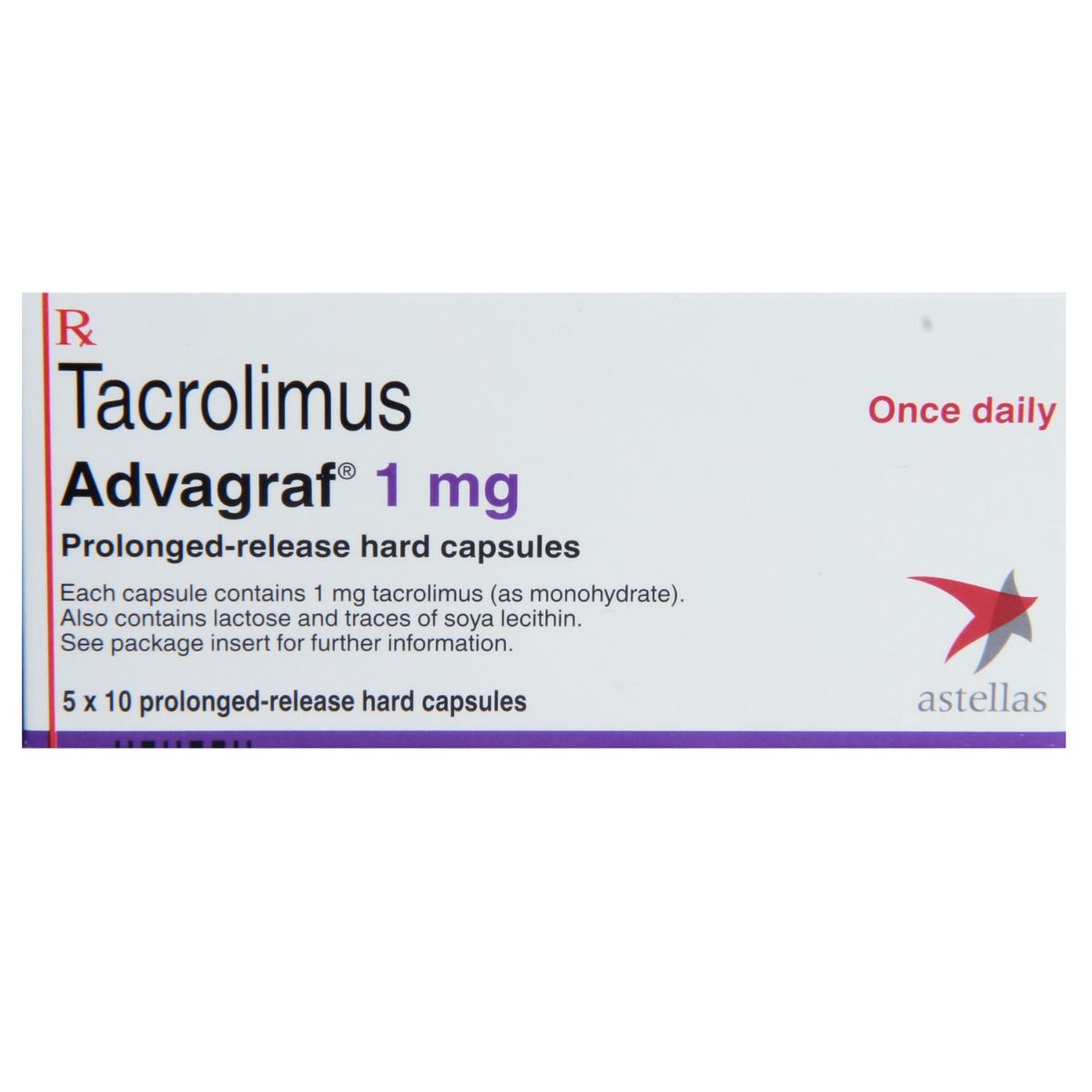
Advagraf 1mg capsule is a prescription –only ,prolonged –release formulation of tacrolimus ,an immunosupressant used to prevent organ rejection in kidney, liver or heart transplant pateints. It works by weakening the immune system to stop it from attacking the transplanted organs.
Immune suppression more commonly referred to immunosuppression or the management of transplant immunology , is the cornerstone of the transplanted care. It involves using medications to deliberately weaken the recipients immune system to prevent it from recognising and destroying the foreign, transplanted organ ,while trying to maintain enough immunity to fight infections.
WHAT IS ADVAGRAF 1MG?
Advagraf 1 mg is a calcineurine inhibitor immunosuppressant containing the active ingredient Tacrolimus. It is a prolonged release once –daily medication used to prevent organ rejection in kidney, liver, or heart transplant patients by weakness the immune system to inhibit T-lymphocyte activation.
Key classification:
- Generic name: Tacrolimus
- Class: immunosuppressant ,calcineurine inhibitor
- Mechanism of action: forms a complex with FKBP-12 ,inhibiting calcineurine phosphatase to suppress t-cell formation.
- Formulation: prolonged release hard capsule
- Common use: prophylaxis of transplant rejection (kidney,liver ,heart).
WHAT ARE THE MEDICAL USES OF ADVAGRAF 1 MG?
Medical uses of Advagraf 1 mg are:
1. Prevention of organ rejection after transplant
Advagraf 1mg is a prolonged –release , prescription only immunosuppressant used to prevent organ rejection after kidney or liver transplants. It works by weakening the immune system , often in combination with other medicines, to prevent the body from attacking the transplanted organ. It contains tacrolimus ,which inhibits T-lymphocyte activity ,suppressing the immune response against the new organ.
2. Used in kidney, liver and heart transplant patients
Advagraf 1 mg is a powerful immunosuppressant medicine used in adult pateints to prevent the immune system from attacking and rejecting a transplanted organ. It is specifically used for:
- Kidney transplant: prevention of rejection
- Liver transplant: prevention of rejection
- Heart transplant: prevention of rejection (and other organs like lungs or pancreas)
- Treatment of rejection: it is also used to treat existing organ rejection that has not responded to other immunosuppressive therapies.
3. Long-term maintenance therapy
Advagraf 1 mg is a once- daily ,prolonged-release formulation of the immunosuppressant tracolimus, used as long-term maintenance therapy to prevent organ rejection in adult kidney or liver transplant recipients. It works by inhibiting the immune system ,specifically T-cells that cause organ rejection. It is desingned for long-term use and must be continued as long as necessary to prevent rejection, there is typically no defined time for therapy.
WHAT ARE THE BENEFITS OF ADVAGRAF 1 MG CAPSULES?
Benefits of Advagraf 1 mg capsules are:
1. Prevents rejection of transplanted organs
Advagraf 1 mg is a prolonged –release immunosuppressant capsule containing tacrolimus, used to prevent organ rejection in adult kidney or liver transplant pateints. It works by weakening the immune system to prevent it from attacking the new organ . it is taken once daily, usually in combination with other immunosuppressants. It is designed to be taken once daily usually in the morning, on an empty stomach .
2. Improves long- term transplant outcomes
Advagraf is designed to improve long-term transplant outcomes, primarily by increasing medication adherence compared to twice-daily formulations. Studies indicate that improved adherence reduces the risk of graft failure and rejection, as non-adherence is a major cause of preventable long-term complications.
3. Reliable and effective immunosuppressive therapy
Advagraf 1 mg is widely recognized as a highly effective and reliable prolonged release immunosuppressant used to prevent organ rejection in adult kidney, and liver transplant patients. As a once-a-day formulation, it offers high reliability by improving treatment adherence compared to twice –daily formulations ,maintaining consistent therapeutic drug levels.
WHAT ARE THE POSSIBLE SIDE EFFECTS OF ADVAGRAF 1 MG?
Possible side effects of Advagraf 1 mg are:
1. Tremors
Tremors (shaking) ,particularly of the hands, are very common side effect of Advagraf 1mg ,affecting more than 1 in 10 patients . these temors are generally considered mild and transient, often appearing early in the treatment or as the body adjusts, but should be reported to a doctor if they are severe ,persistent or bothersome. As a potent immunosuppressant, tracolimus is frequently associated with neurological side effects ,including tremors .
2. High blood pressure
Advagraf 1mg commonly causes high blood pressure (hypertension) as a side effect. It is a very common side effect, affecting more than 1 in 10 users . high blood pressure can occur or worsen during treatment, often requiring frequent monitoring of blood pressure levels by a doctor. Tacrolimus may cause sodium retention and increase vascular contractility, leading to higher blood pressure .
3. kidney function changes
Advagraf 1 mg commonly causes kidney-related side effects because it is a potent immunosuppressant that can cause nephrotoxicity . it may cause acute kidney injury, chronic kidney impairment and high blood Pottasium, requiring regular mandatory blood monitoring of kidney function, especially in transplant patients. It can be tough on the kidneys , with potential for both sudden and long-term (chronic) harm. It can also cause an abnormal increase in serum creatinine levels.
CONCLUSION
Based on clinical studies, Advagraf 1 mg is a highly effective and considered a reliable alternative to twice-daily formulations ,improving patient adherence while maintaining similar, safe and effective immunosuppression . Advagraf 1 mg is effective at preventing graft rejection in adult liver and kidney transplant recipients. Studies have demonstrated that it is not inferior to program in maintaing stable transplant function.
FREQUENTLY ASKED QUESTIONS (FAQs):
QUESTION: HOW LONG SHOULD ADVAGRAF BE TAKEN?
Advagraf is designed for long-term daily use ,typically for the rest of ones life, to prevent organ rejection after a kidney or liver transplant. Because it is crucial to keep the transplanted organs safe, there is usually no specified limit to the duration of this therapy.
QUESTION: CAN IT BE TAKEN WITH OTHER TRANSPLANT MEDICATIONS?
Yes, advagraf is commonly taken with transplant medications, specifically as a part of a multi-drug regimen to prevent organ rejection . it is typically used alongside corticosteroids and mycophenenolate mobile (MMF) in kidney or liver transplant patients, though close monitoring is required due to potential drug interactions and side effects.
REFRENCES:
1)https://www.apollopharmacy.in/medicine/advagraf-1mg-capsule?srsltid=AfmBOooRqYKSd-DRIDx2H9HIfQUr87hdUjcfCbsncPrdaLUpI6Kxj9Be
2)https://www.medibuddy.in/order-medicines/advagraf-1mg-capsule-pr-1000057650